


Published: October 2026
Introduction
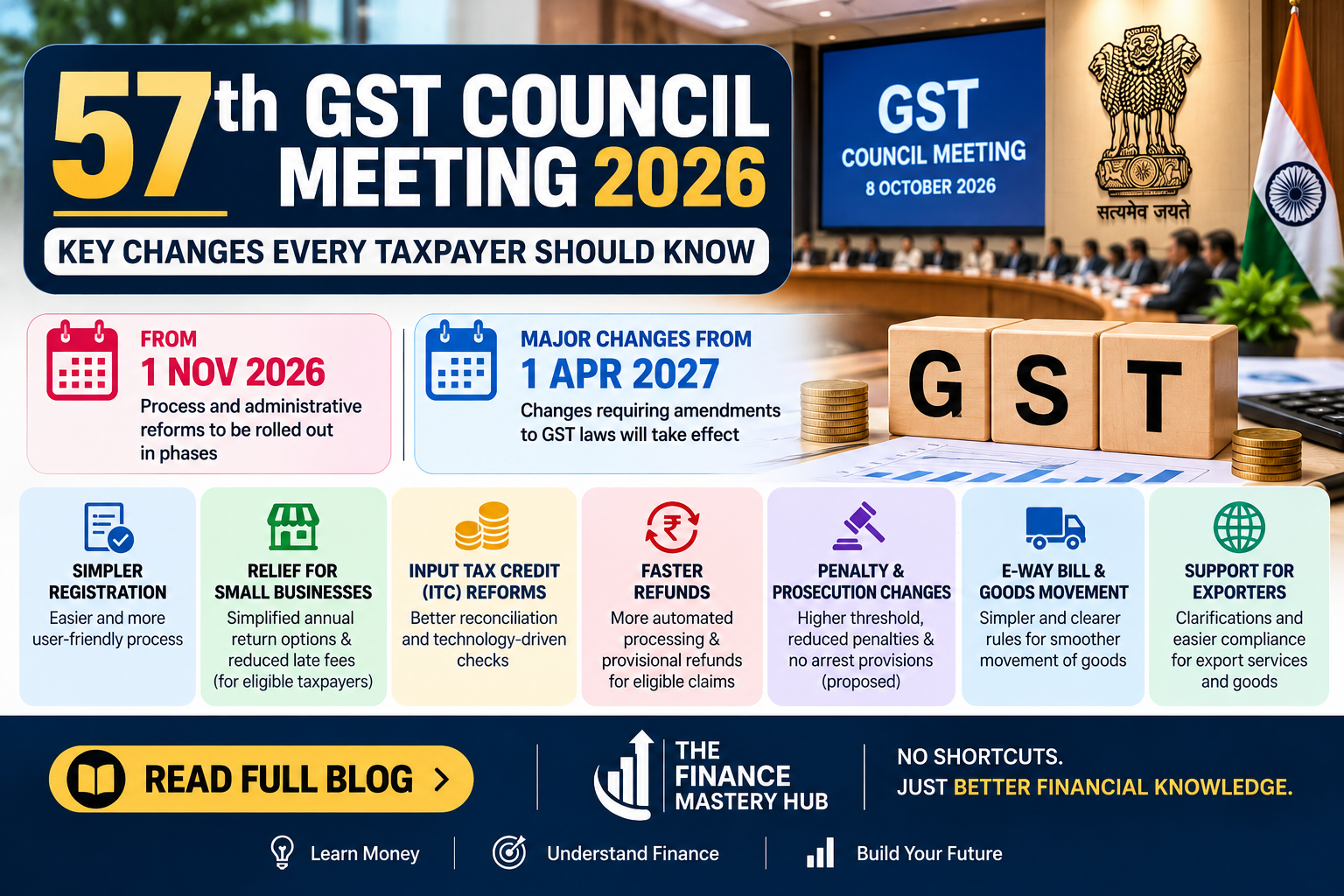
The 57th GST Council meeting was held on 8 October 2026 in New Delhi. The meeting focused on making GST compliance easier, improving the flow of Input Tax Credit (ITC), speeding up refunds and reducing unnecessary disputes between taxpayers and the tax department.
Some reforms are expected to begin in phases from 1 November 2026, while changes requiring amendments to GST laws are targeted for 1 April 2027. However, these dates do not mean every proposal becomes effective automatically. Taxpayers should check the applicable government notifications and GST portal updates before changing their compliance process.
The main objective is to make GST administration simpler, more transparent and more technology-driven.
1. Key Changes Recommended in the 57th GST Council Meeting
1. Simpler GST Registration
The Council recommended improvements to the GST registration process, including clearer documentation requirements, a more user-friendly application and better guidance on the GST portal.
It also recommended simplifying certain amendments to registration details, reducing unnecessary officer intervention and making eligible changes easier to process.
What taxpayers should do:
- Keep PAN, business address, bank details and supporting documents updated.
- Check registration applications carefully before submitting them.
- Monitor GST portal announcements for the implementation of the proposed changes.
2. Easier GST Compliance for Small Businesses
The Council approved, in principle, an optional Annual Return Quarterly Payment (ARQP) scheme for eligible businesses with annual turnover of up to ₹5 crore that make supplies exclusively to unregistered customers (B2C).
Under the proposed scheme, eligible businesses would file an annual return and make tax payments quarterly. The exact eligibility requirements and implementation details should be checked when the official rules are issued.
The Council also recommended relief from late fees for eligible taxpayers with turnover up to ₹5 crore in the preceding financial year, where delayed returns are filed by the end of the month in which they were due.
What small businesses should do:
- Review their turnover and customer categories.
- Continue following their existing return-filing schedule until the new scheme is officially available.
- Check whether the proposed scheme is suitable for their business before opting in.
3. Better Input Tax Credit (ITC) Reconciliation
Input Tax Credit allows eligible registered businesses to claim credit for GST paid on business purchases, subject to applicable conditions.
The Council recommended improvements to the reconciliation of GSTR-1, GSTR-3B and GSTR-2B. It also proposed electronic statements to help taxpayers report reverse-charge tax, ITC reversals and reclaimed credit more accurately.
The proposed alternative mechanism for correcting tax liabilities and ITC mismatches is targeted for the April 2027 return period.
What taxpayers should do:
- Reconcile purchase records with GSTR-2B regularly.
- Compare outward supplies reported in GSTR-1 with tax liabilities in GSTR-3B.
- Follow up with suppliers on missing or incorrect invoices.
- Maintain proper records of ITC reversals and subsequent reclaims.
- Review reverse-charge transactions carefully.
These steps can help reduce avoidable mismatches, notices and disputes.
4. Faster GST Refunds
The Council recommended a more automated refund process for eligible claims, including refunds relating to excess balances in the electronic cash ledger, zero-rated supplies and the inverted duty structure.
The proposals include automatic processing of eligible cash-ledger refunds and provisional sanction of 90% of eligible claims relating to zero-rated supplies and inverted duty structure, based on system risk assessment.
The changes are intended to reduce manual intervention and improve business cash flow.
What exporters and other eligible taxpayers should do:
- Keep export invoices and supporting documents organised.
- Reconcile refund claims with returns and electronic ledgers.
- Ensure bank details and refund applications are accurate.
- Monitor official notifications to understand when each refund facility becomes operational.
A faster process does not mean every refund will be approved automatically; eligibility checks and applicable conditions will continue to matter.
5. Wider ITC Refund Eligibility
The Council recommended expanding refund eligibility for certain accumulated ITC.
Under the recommendations:
- Eligible ITC on input services relating to the inverted duty structure may qualify for refunds for credit availed on or after 1 November 2026.
- Refunds of eligible ITC on capital goods for zero-rated supplies and the inverted duty structure are proposed for credit availed on or after 1 April 2027, with the capital-goods refund spread over 60 months.
- Restrictions on ITC for certain categories, including specified insurance, catering and other supplies, are proposed to be revised through amendments.
These are subject to the applicable legal amendments, notifications and conditions. Businesses should not assume that every previously restricted credit is immediately claimable.
6. Changes to Penalties, Prosecution and Arrest Provisions
The Council recommended changes intended to reduce the compliance burden and provide greater certainty to taxpayers.
Major proposals include:
- Raising the prosecution threshold from ₹1 crore to ₹5 crore.
- Reducing the maximum general penalty under Section 125 of the CGST Act from ₹25,000 to ₹10,000.
- Removing GST arrest powers through a proposed amendment to the law.
- Introducing a minimum threshold of ₹10,000 for certain show-cause notices, subject to the proposed provisions.
- Providing for reduced penalties in specified non-fraud cases when tax and interest are paid within the prescribed time.
Important: These are recommendations requiring relevant legal changes. Taxpayers should not interpret them as an immediate exemption from existing GST obligations, penalties or enforcement provisions.
Businesses should continue to file returns accurately, pay tax on time and respond appropriately to official notices.
7. Easier GST Registration for Certain E-commerce Sellers
The Council recommended a simplified registration mechanism for eligible small suppliers selling goods through e-commerce platforms in states or union territories where they do not have a physical business presence.
Subject to conditions, eligible sellers may be able to use an e-commerce operator’s warehouse in that state or union territory as their principal place of business for the proposed mechanism.
What sellers should do:
- Review the eligibility conditions before expanding to another state.
- Keep stock, invoice and warehouse records accurate.
- Follow the applicable registration and e-commerce compliance requirements.
8. Improved Rules for Movement of Goods
The Council recommended changes to e-way bill and goods-interception provisions to support smoother movement of goods between states.
The proposals include restricting certain interceptions to cases supported by specific intelligence and authorised officers, while retaining inspection powers in specified circumstances.
Businesses transporting goods should continue to ensure that invoices, e-way bills and other required documents are valid and available during transit. Do not assume that the proposed reforms remove existing documentation requirements.
9. Support for Exporters and International Service Providers
The Council recommended changes intended to clarify when certain services supplied to or through overseas offices and branches may qualify as exports of services.
It also recommended clarifications on payment in foreign currency or Indian rupees where permitted, subject to applicable requirements.
What exporters and service providers should do:
- Review contracts, invoices and payment records.
- Confirm that the transaction satisfies the applicable export-of-services conditions.
- Check the relevant notifications before claiming zero-rated treatment or a refund.
- Seek professional advice for complex cross-border arrangements.
Having a foreign customer does not automatically mean that every service qualifies as an export under GST.
2. Important Dates to Remember
| Date | What taxpayers should know |
|---|---|
| 1 November 2026 | Proposed start for certain reforms not requiring major statutory amendments; specified input-service ITC refund changes are also proposed from this date. |
| April 2027 return period | Proposed start of the alternative mechanism for correcting certain tax liability and ITC mismatches. |
| 1 April 2027 | Target date for certain reforms requiring amendments to GST laws, including specified capital-goods ITC refund changes. |
These are expected or proposed implementation dates, not a guarantee that every measure will commence on the same date. Always check the relevant notification or circular.
3. GST Compliance Checklist for Taxpayers
Whether you are a small business owner, trader, service provider, exporter or accountant, these practical steps can help you prepare:
- File GSTR-1 and GSTR-3B accurately and within the applicable deadlines.
- Reconcile GSTR-2B with purchase records before claiming ITC.
- Follow up on supplier invoices that are missing or incorrect.
- Maintain records for reverse-charge transactions, ITC reversals and reclaims.
- Keep GST registration and bank details updated.
- Maintain proper invoices, e-way bills and supporting documents.
- Review refund eligibility and retain evidence supporting refund claims.
- Monitor official GST notifications and portal updates before applying new procedures.
- Do not claim ITC or apply a new tax treatment solely on the basis of a news report.
4. Are the 5%, 18% and 40% GST Rates New From the 57th Meeting?
No. The simplified structure of two main rates—5% and 18%—along with a special 40% rate for selected goods and services was part of the GST 2.0 rate reforms recommended at the 56th GST Council meeting.
The 57th meeting primarily focused on process reforms, registration, returns, refunds, ITC and enforcement. Taxpayers should check the applicable rate notification and product or service classification rather than assume that all goods and services fall under only these three rates.
Conclusion
The 57th GST Council meeting proposed several changes intended to simplify GST compliance, improve refund processing, strengthen ITC reconciliation and reduce unnecessary disputes.
For taxpayers, the most useful action is to maintain accurate records, reconcile returns regularly, review refund eligibility and follow official notifications as the reforms are implemented in phases.
Remember: A Council recommendation is not always immediately enforceable law. The relevant notification, circular or statutory amendment determines when a change applies and what conditions taxpayers must follow.
At The Finance Mastery Hub, our goal is to explain finance and taxation in simple language so readers can make informed decisions. This article is for educational purposes only and is not a substitute for professional tax advice.