

An invoice is no longer just a piece of paper. For many businesses in India, invoices must now be electronically reported to the GST Invoice Registration Portal. But what exactly is an e-invoice, and which taxpayers are required to generate one?
What Is GST E-Invoice?
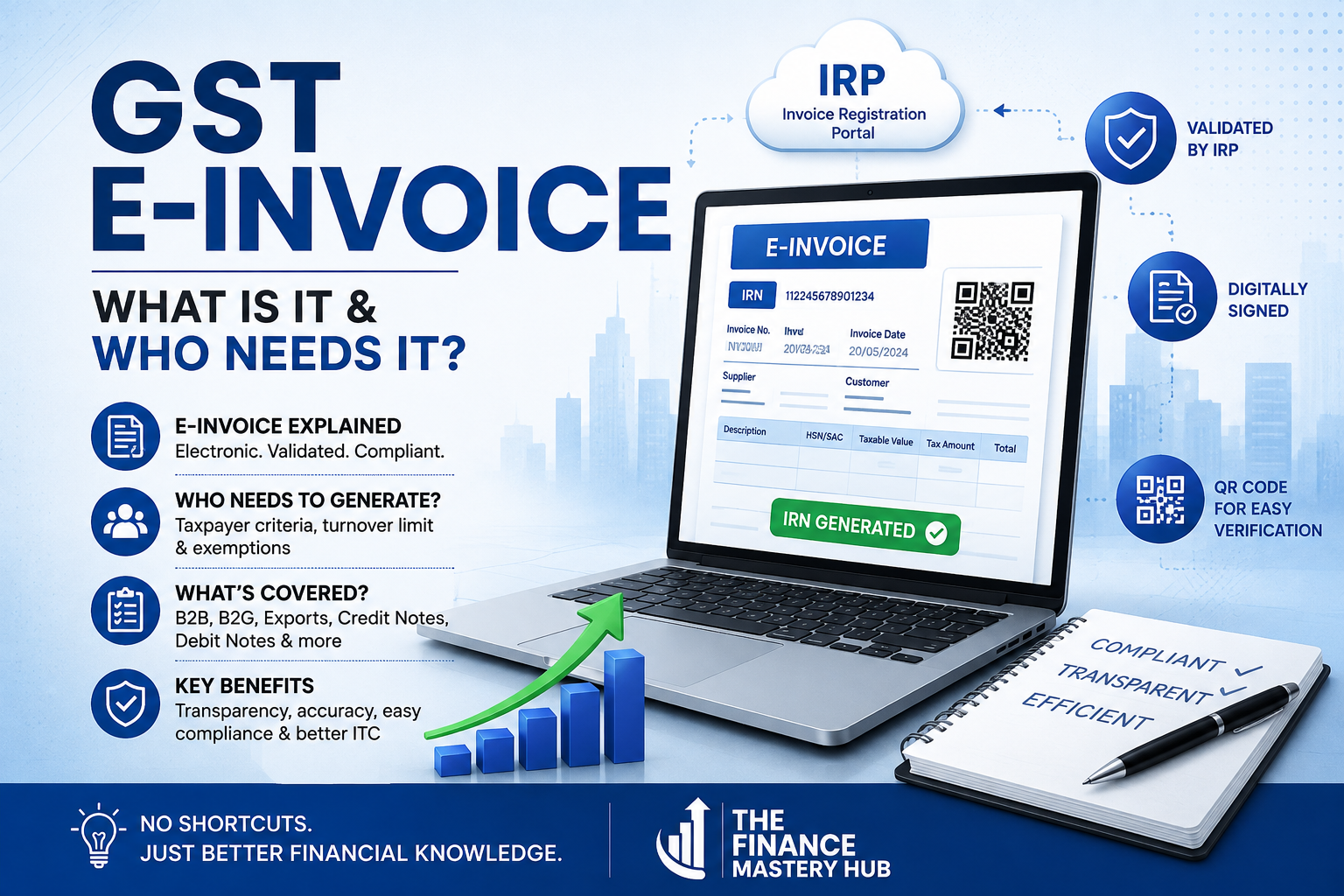
E-invoice means an invoice that is electronically reported to the Invoice Registration Portal (IRP) under the GST e-invoicing system.
One important point is that e-invoicing does not mean that the government creates your invoice.
The business generally prepares the invoice using its accounting, billing or ERP software and then reports the required invoice details to an authorised IRP. The IRP validates the information and generates an Invoice Reference Number (IRN) and a digitally signed QR code.
The e-invoice system also allows relevant invoice information to flow to the GST system, reducing the need for businesses to manually enter the same information again for GST reporting.
Why Was E-Invoicing Introduced?
The main purpose of e-invoicing is to make GST reporting more efficient and improve transparency.
It can help:
- Reduce manual data-entry errors
- Improve GST reconciliation
- Reduce invoice mismatches
- Make invoice reporting more systematic
- Improve verification of Input Tax Credit
- Help reduce fake invoicing and tax fraud
The system connects business invoicing with GST reporting through the Invoice Registration Portal.
Who Is Required to Generate E-Invoices?
This is one of the most important points for businesses.
Currently, e-invoicing applies to taxpayers whose Aggregate Annual Turnover (AATO) is ₹5 crore or more in any preceding financial year from FY 2017-18 onwards, subject to the applicable exemptions. The ₹5 crore threshold has been applicable from 1 August 2023.
What Does “Aggregate Annual Turnover” Mean?
For e-invoicing, the turnover threshold is considered on a PAN basis, taking into account the aggregate turnover of the taxpayer across GST registrations, as applicable.
Therefore, a business should not look at only one GSTIN’s turnover when determining whether the e-invoicing threshold is crossed.
Simple Rule to Remember
If your aggregate turnover was ₹5 crore or more in any preceding financial year from FY 2017-18 onwards, check whether e-invoicing applies to you.
However, turnover alone is not the only factor. The taxpayer’s type and applicable exemptions also need to be considered.
Which Transactions Are Covered by E-Invoicing?
For taxpayers covered by the mandate, e-invoicing generally applies to specified documents and transactions, including:
- B2B supplies
- B2G supplies
- Exports
- Deemed exports
- Supplies to SEZ developers
- Supplies to distinct persons
- Credit notes
- Debit notes
The exact applicability depends on the nature of the transaction and the GST rules.
Is E-Invoice Required for B2C Sales?
Generally, B2C invoices are not covered by the GST e-invoice mandate.
This is an important distinction.
A taxpayer may be required to generate e-invoices for specified B2B transactions while ordinary B2C transactions are not covered by the same e-invoicing requirement.
Who Is Exempt From GST E-Invoicing?
Certain categories of taxpayers are specifically exempt from mandatory e-invoicing even if they meet the applicable turnover threshold.
The listed exemptions include:
- Banks
- Insurance companies
- Financial institutions, including NBFCs
- Goods Transport Agencies (GTA)
- Suppliers of passenger transportation services
- Suppliers of services relating to admission to exhibition of cinematograph films
- SEZ units
An important distinction is that SEZ developers are not covered by the same exemption as SEZ units; eligible SEZ developers can be subject to e-invoicing.
The exemption is generally for the entity as a whole, rather than being restricted to only a particular type of supply made by that entity. CBIC has specifically clarified this position.
What Is IRN?
IRN stands for Invoice Reference Number.
When a covered invoice is successfully reported to the Invoice Registration Portal, the system generates an IRN for that invoice.
The IRN provides a unique reference for the reported document and is an important part of the e-invoice system.
What Is the QR Code on an E-Invoice?
An e-invoice contains a QR code generated as part of the IRP process.
The QR code helps verify important information associated with the e-invoice.
This makes it easier for businesses and recipients to validate whether an invoice has been successfully reported and registered.
What Happens After an Invoice Is Generated?
The basic process is:
1. Business prepares the invoice
The taxpayer creates the invoice using its accounting, billing or ERP system.
2. Invoice data is reported to the IRP
The required information is sent electronically to an authorised Invoice Registration Portal.
3. IRP validates the invoice
The system processes the submitted information.
4. IRN is generated
A unique Invoice Reference Number is generated.
5. QR code and digital signature are provided
The registered invoice receives the relevant IRP authentication information.
6. Invoice is shared with the customer
The taxpayer can then issue/share the e-invoice with the required details.
Does E-Invoice Mean You Don’t Need Accounting Software?
No.
A business still needs an accounting, billing or ERP system to prepare its invoices.
The e-invoicing system is the reporting and registration mechanism through which eligible invoices are submitted to the IRP.
Many businesses integrate their accounting or ERP systems with an IRP/API solution so that the process can be automated.
What Happens If E-Invoicing Is Applicable but the Business Doesn’t Follow It?
Businesses covered by the e-invoicing mandate need to follow the applicable GST requirements.
Failure to comply can create GST compliance issues and may affect the validity and tax treatment of invoices.
Therefore, businesses crossing the applicable threshold should check their e-invoice applicability and put the required system in place before the requirement becomes a compliance problem.
Important 30-Day Reporting Rule
There is an additional important compliance requirement for larger taxpayers.
From 1 April 2025, taxpayers with AATO of ₹10 crore or more are required to report invoices, credit notes and debit notes to the IRP within 30 days from the document date. The IRP system restricts reporting beyond this period.
So, businesses with ₹10 crore or more AATO should pay particular attention to timely e-invoice reporting.
E-Invoice vs Normal Invoice
The easiest way to understand the difference is:
Normal GST Invoice:
The business prepares and issues a GST invoice according to the applicable GST rules.
GST E-Invoice:
For taxpayers covered by the e-invoice mandate, the invoice details must also be reported to an authorised IRP and receive an IRN and other required authentication details.
So, e-invoicing is not a completely different type of commercial invoice—it is a GST reporting and registration process for specified invoices.
Key Points Every Business Should Remember
- E-invoice is part of India’s GST compliance system.
- It involves electronically reporting specified invoices to an authorised Invoice Registration Portal (IRP).
- The current turnover threshold is ₹5 crore or more in any preceding financial year from FY 2017-18 onwards, subject to applicable exemptions. (eInvoice)
- Turnover is considered on the applicable PAN-level aggregate turnover basis. (GST Tutorials)
- E-invoicing generally covers specified B2B, B2G, export and other notified transactions.
- Ordinary B2C transactions are generally outside the e-invoice mandate. Certain entities, including banks, insurance companies, NBFCs, GTAs and specified passenger transport providers, are exempt.
- An eligible e-invoice receives an IRN and QR code through the IRP process.
- Taxpayers with ₹10 crore or more AATO must report covered invoices, credit notes and debit notes within 30 days from the document date.
Final Thoughts
GST e-invoicing is an important part of India’s move toward more digital and transparent tax compliance.
For a small business owner, the most important questions are simple:
Is my business covered by the ₹5 crore threshold?
Did my aggregate turnover cross the threshold in any preceding financial year?
Is my entity exempt from e-invoicing?
Which of my transactions require e-invoicing?
Am I following the applicable reporting timelines?
Understanding these points can help businesses avoid unnecessary compliance problems.
E-invoicing is not about making taxation more complicated. Its broader purpose is to make invoice reporting more standardised, transparent and connected with the GST system.
This article is for educational and informational purposes only. GST rules, thresholds, exemptions and reporting requirements may change. Businesses should verify the latest notifications and advisories on the official GST/e-invoice portals or consult a qualified tax professional for their specific circumstances.