

You see GST on your restaurant bill, shopping bill, hotel invoice and many other purchases. But what exactly is GST, why do we pay it, and how does it affect our everyday life?
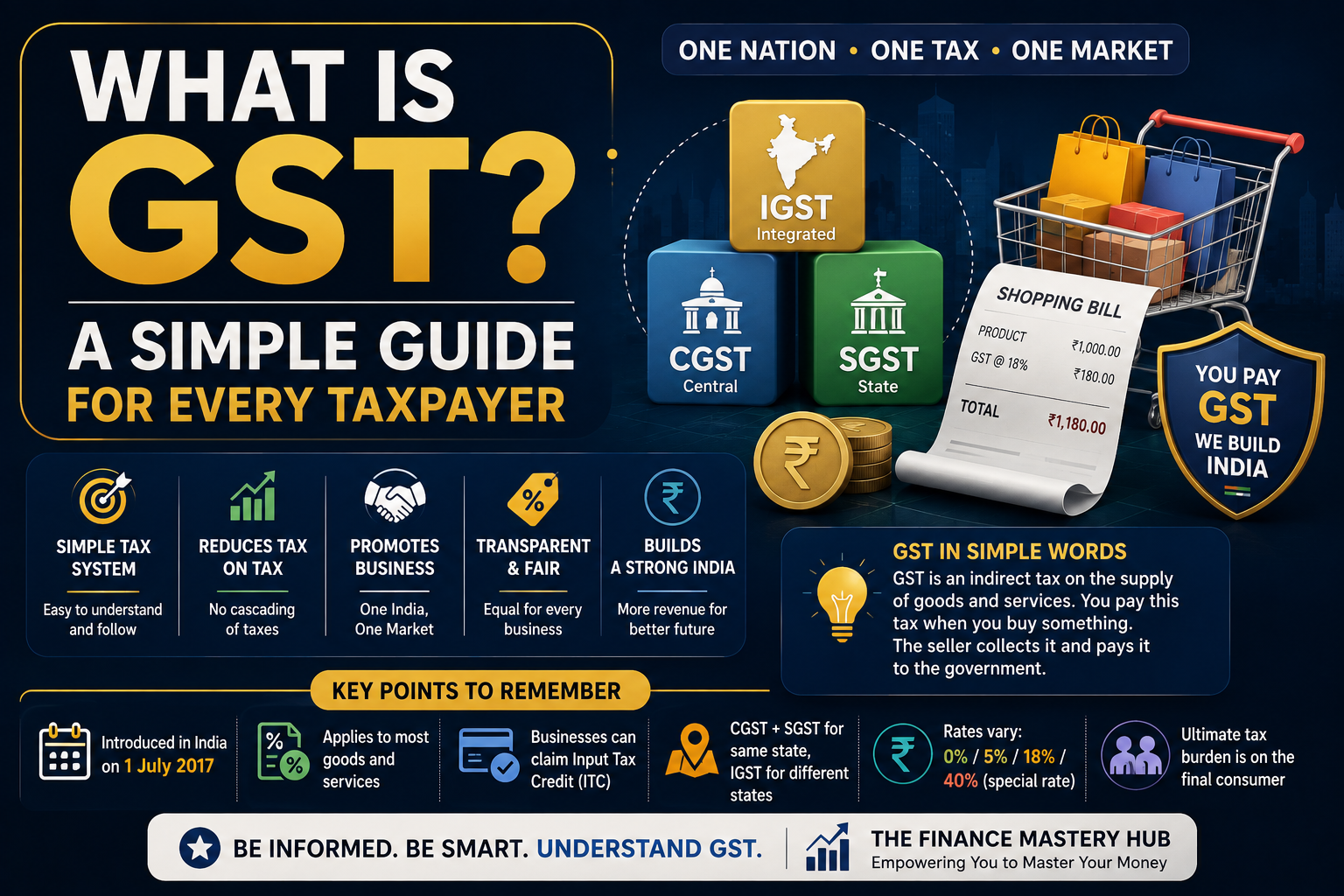
GST stands for Goods and Services Tax. It is an indirect tax charged on the supply of goods and services in India.
In simple words, when you buy a taxable product or service, GST is generally included in the price you pay. The seller collects the tax and deposits it with the government according to the GST rules.
GST was introduced in India on 1 July 2017 to create a more unified indirect tax system and replace several central and state-level indirect taxes with a common framework.
Why Was GST Introduced?
Before GST, India had several different indirect taxes, such as VAT, service tax and central excise duty. Different taxes applied at different stages and could make the tax system complicated.
GST was introduced to simplify the indirect tax structure and reduce the cascading effect of taxes, where tax could effectively be charged on an amount that already included an earlier tax.
One of the key features of GST is Input Tax Credit (ITC). Eligible businesses can generally claim credit for GST paid on eligible business purchases and use it against their output GST liability, subject to the conditions of the law.
How Does GST Work?
GST is based on the concept of taxing the supply of goods and services.
A business may purchase inputs, add value to them and sell the resulting goods or services. At each stage, GST can be charged on the taxable supply.
Eligible businesses can generally claim credit for qualifying GST paid on their business inputs. This helps prevent the tax from unnecessarily accumulating through the supply chain.
For the final consumer, however, GST generally becomes part of the cost because an ordinary consumer cannot claim business Input Tax Credit on personal purchases.
What Are CGST, SGST and IGST?
There are three important GST terms that taxpayers should understand:
CGST – Central Goods and Services Tax
CGST is the Central Government’s component of GST and is generally charged on taxable intra-State supplies along with SGST or UTGST.
SGST – State Goods and Services Tax
SGST is the State Government’s component and is generally charged on taxable intra-State supplies.
IGST – Integrated Goods and Services Tax
IGST generally applies to inter-State supplies, where goods or services are supplied from one state to another.
The simple way to remember it is:
Same State → CGST + SGST/UTGST
Different States → IGST
The exact treatment can depend on the GST place-of-supply rules.
What Are GST Rates?
GST does not have one single rate for every product and service.
Different goods and services can fall under different tax rates, including nil/exempt treatment, 5%, 18% and specified higher rates, depending on their classification and applicable rules.
Following the GST rate rationalisation implemented from 22 September 2025, the main structure was simplified around a 5% merit rate and an 18% standard rate, along with a 40% special rate for specified goods and services. Some goods and services continue to have different or exempt treatment. (pib.gov.in)
Therefore, you should always check the current GST rate applicable to the specific product or service rather than assuming that everything attracts 18% GST.
What Is Input Tax Credit?
Input Tax Credit, or ITC, is one of the most important features of GST.
It allows eligible registered businesses to generally reduce their GST liability using GST paid on eligible business purchases, subject to the conditions and restrictions under GST law.
This mechanism helps reduce the cascading effect of taxation.
However, GST paid on every purchase does not automatically qualify for ITC. The purchase must meet the applicable requirements.
Who Has to Register for GST?
GST registration is mainly relevant to businesses and other persons who meet the applicable registration requirements.
Registration depends on factors such as:
- Turnover
- Type of business
- Goods or services supplied
- State or location
- Nature of supply
- Specific compulsory-registration provisions
Therefore, there is no single rule that applies to every business.
Once registered, a taxpayer receives a GSTIN (Goods and Services Tax Identification Number) and must follow the applicable GST compliance requirements.
What Is GSTIN?
GSTIN is the 15-digit identification number issued to a registered GST taxpayer.
You may see a business’s GSTIN on its tax invoice.
Consumers can also use the GST system to verify information about registered taxpayers.
Does GST Affect Normal People?
Yes.
Even if you are not a business owner or GST-registered taxpayer, GST can affect you every day.
When you purchase taxable goods or services, GST can form part of the final price.
This means GST can affect your:
- Household expenses
- Shopping bills
- Restaurant bills
- Travel expenses
- Hotel expenses
- Professional services
- Electronics purchases
- Vehicle purchases
- Other taxable goods and services
Understanding GST therefore helps ordinary people understand where their money is going.
GST vs Income Tax
GST and income tax are not the same.
GST is an indirect tax generally collected through the supply chain on taxable supplies.
Income tax is a direct tax imposed on taxable income under income-tax law.
For example, you may pay income tax on your taxable income and also pay GST when you purchase taxable goods or services.
Both are taxes, but they work in very different ways.
Who Decides GST Rates?
GST policy and rate recommendations are made through the GST Council, a constitutional body consisting of representatives of the Union and state governments.
GST rates and other provisions can change over time based on government decisions, GST Council recommendations and legal notifications.
This is why taxpayers should avoid relying on old GST information found on social media or outdated articles.
Why Should You Understand GST?
You don’t need to become a tax expert to understand GST.
But knowing the basics can help you:
- Understand your bills
- Know what GST means
- Understand why prices change
- Recognise CGST, SGST and IGST
- Understand the basic idea of Input Tax Credit
- Avoid confusion about GST rates
- Understand your business tax responsibilities if you are a business owner
Financial literacy is not only about saving and investing money.
It is also about understanding the taxes that affect the money you spend.
GST in Simple Words
If we explain GST in one sentence:
GST is an indirect tax on the supply of goods and services in India, collected through the supply chain, with eligible businesses generally allowed to claim credit for qualifying GST paid on business inputs.
For a normal consumer, the most important thing to remember is that GST is generally included in the cost of taxable goods and services you purchase.
For a business owner, GST is much more important because it involves registration, invoicing, Input Tax Credit, returns, payments and other compliance requirements.
Key GST Points You Should Remember
GST = Goods and Services Tax
GST is an indirect tax.
GST was introduced in India on 1 July 2017.
GST applies to taxable supplies of goods and services.
CGST + SGST/UTGST generally applies to intra-State supplies.
IGST generally applies to inter-State supplies.
Eligible businesses can generally claim Input Tax Credit, subject to GST rules.
GST rates differ depending on the goods or services.
GST rates and rules can change, so current official information should always be checked.
The final consumer generally bears the GST cost on taxable consumption.
Final Thoughts
GST may sound complicated because of terms such as CGST, SGST, IGST and Input Tax Credit.
But the basic concept is simple.
GST is India’s main indirect tax framework for taxable goods and services.
As a consumer, GST can affect the price you pay.
As a business owner, GST can affect your pricing, cash flow, accounting and compliance.
And as a financially aware person, understanding GST helps you make better decisions about your money.
You don’t need to be a tax expert. You just need to understand the basics.
This article is for general educational purposes only and does not constitute professional tax advice. GST rates and rules can change, so always verify the latest applicable provisions through official government sources.